How Incrementality Testing Works in Practice
Incrementality testing measures the additional impact that an out-of-home (OOH) advertising campaign delivers beyond what would have happened anyway. It answers the question: what outcomes can be directly attributed to OOH exposure, above baseline behaviour and other media effects?
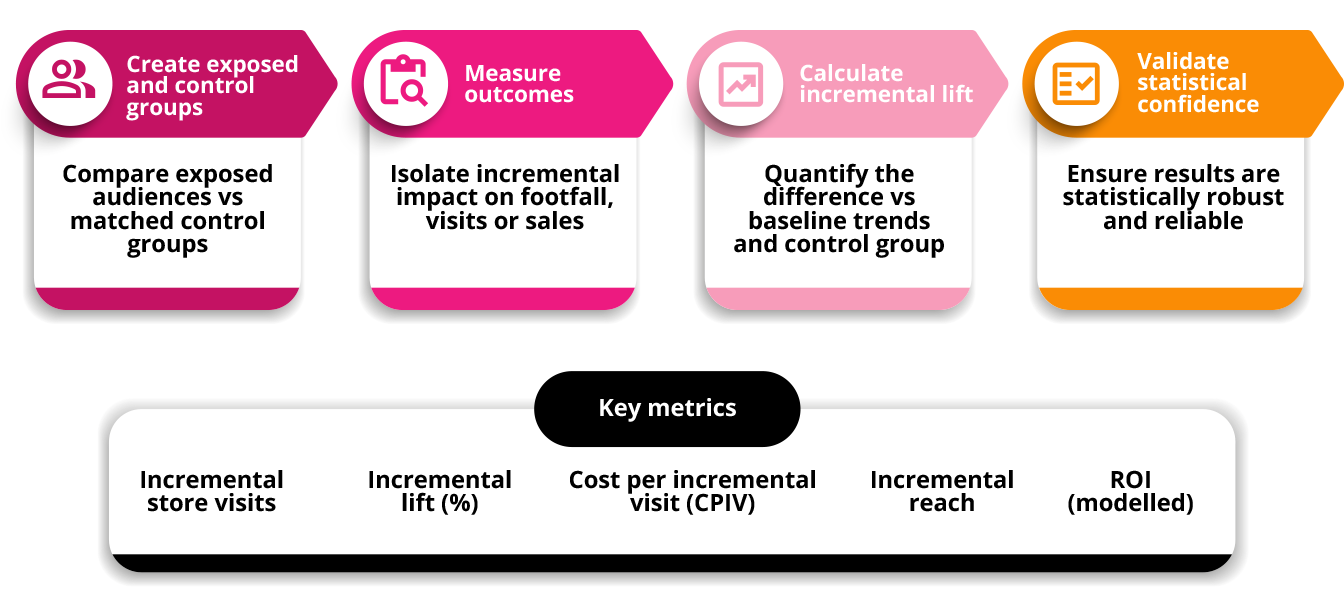
How Incrementality Testing Works in Practice
- Exposed and Control Groups
Audiences or locations are split into exposed and control groups. Exposed groups have a high probability of seeing the campaign, while control groups have little or no exposure. These groups are carefully matched on historical performance, demographics, location type, and seasonality. For OOH these are typically done at regional level.
- Outcome Measurement
Outcomes such as store visits, footfall, or sales are measured consistently across both groups during and after the campaign period. Other softer measures such as brand awareness, consideration, intention to purchase are also tracked depending on the objectives of the campaign.
- Incremental Lift Calculation
Incremental impact is calculated as the difference in outcomes between exposed and control groups, adjusted for baseline trends and external factors.
- Statistical Validation
Confidence intervals and significance testing are applied to ensure results reflect genuine advertising impact rather than natural variation.
Key Metrics Used
The metrics for each test will depend on the objective of the campaign. Typically this will include some of the following:
- Incremental Store Visits
- Incremental Lift (%)
- Incremental Reach
- Brand Awareness
- Brand Consideration
- Purchase Intent
- Cost per Incremental Visit
- Incremental Conversion Rate
- ROI / ROAS (Modelled)


